The main benefits of karate for children include improved cardiovascular fitness, full-body coordination, sharpened mental focus, and stronger emotional self-control.
Unlike high-pressure competitive sports, traditional karate provides a structured, individual path where kids develop strength and self-defense skills without the fear of letting down a team or sitting on the sidelines.
Quick Summary: Core Benefits of Karate for Kids
- Physical Literacy: Builds balanced muscular symmetry, core stability, and balance without unilateral joint strain.
- Cognitive Focus: Strengthens executive function, working memory, and selective attention in the classroom.
- Emotional Regulation: Teaches nervous system regulation, impulse control, and peaceful conflict resolution.
- Inclusive Participation: Delivers 100% active mat time in every class, making it ideal for high-energy children and kids with ADHD or sensory sensitivities.
Is Martial Arts Safe for Young Children?
For many parents in our Monroe County community, considering martial arts brings up valid concerns:
- Will punching and kicking encourage rough behavior at home?
- Is it safe for younger, developing joints?
The reality of traditional karate is quite the opposite. When taught in a positive, professional dojo, karate is a character-building discipline that teaches children how to stay calm, resolve conflict peacefully, and channel their natural energy into focused personal growth.
Conveniently located at 4410 Dewey Avenue in Greece, NY 14616, Murray’s Martial Arts welcomes families from Northwest Greece, Greece West, Hilton, Parma, and Irondequoit, as well as communities across greater Monroe County, including Rochester, Brighton, Henrietta, Webster, and Fairport.
Here, children discover that martial arts is not about fighting: it is about building the physical health, emotional balance, and mental resilience needed for everyday life.
The Big Parental Question: Will Karate Make My Child Aggressive or Cause Injury?
One of the most common hesitations parents have is the fear that martial arts will promote violent behavior. In reality, traditional karate places self-defense and peaceful conflict resolution at the center of every lesson.
From day one, children are taught that physical technique is strictly a last resort. Instructors emphasize that true strength lies in restraint, self-awareness, and respect.
In fact, research into youth martial arts programs consistently reveals that children who train regularly exhibit less impulsive aggression than peers who do not.
By learning how to control their physical power in a supervised setting, children gain the maturity to walk away from playground conflicts rather than escalate them.
Karate Safety for Kids: How We Keep Your Child Safe on the Mat
Hospital-Grade Mat Sanitation:
Mats are thoroughly sanitized daily with hospital-grade, child-safe disinfectants to maintain pristine skin health and hygiene.
Shock-Absorbing Matting:
Classes take place on high-density, padded mats designed to cushion growing joints during jumping and footwork drills.
Non-Contact Foundations:
Beginner students work exclusively on movement mechanics, balance games, and striking padded targets held by instructors.
Supervised Sparring Rules:
Sparring is never introduced to beginners. Students only begin controlled point-sparring drills after earning their Yellow Belt and demonstrating emotional maturity.
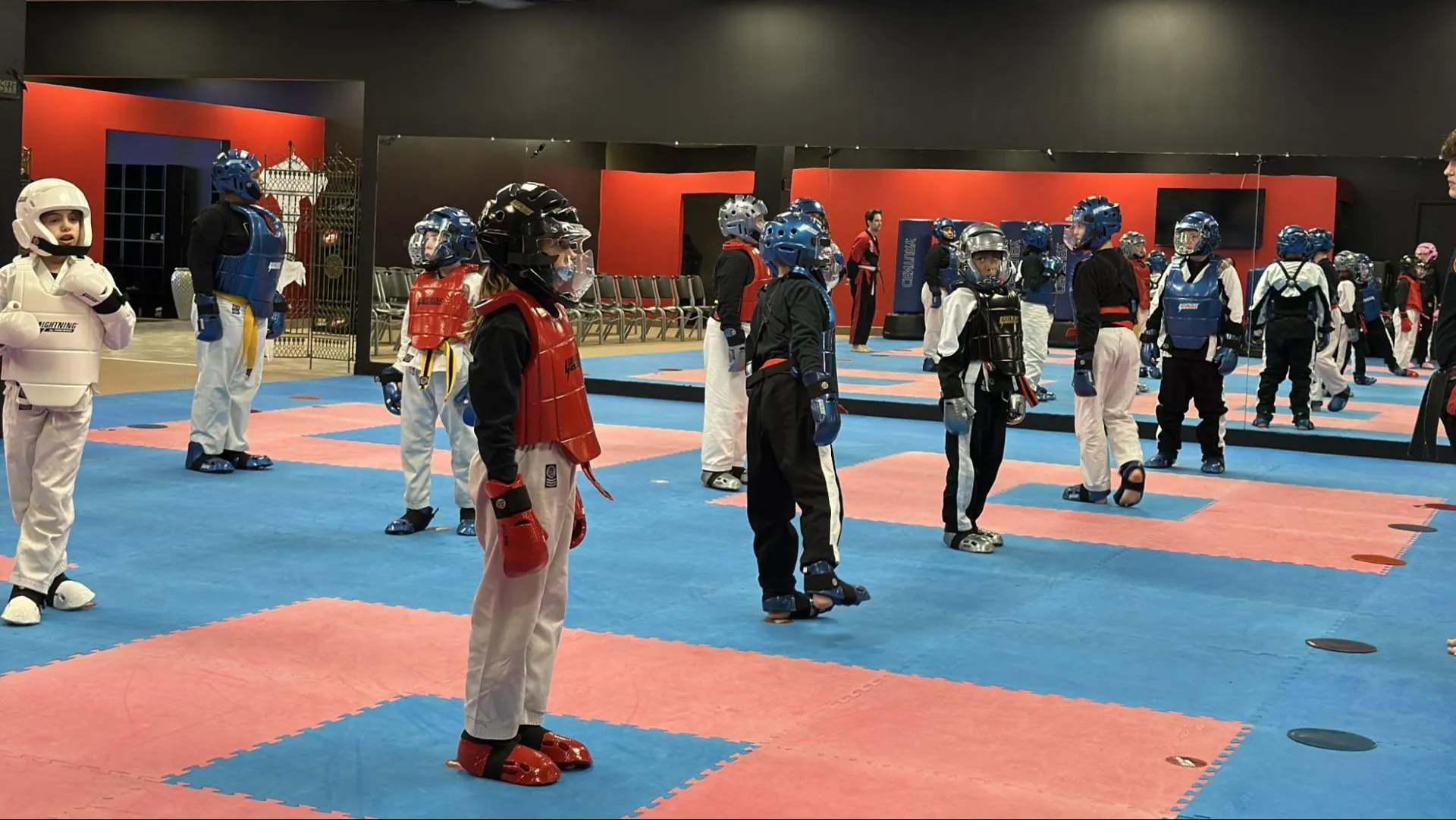
Full protective gear (headgear, hand gear, feet gear, chest guards, mouthguards, and groin protectors) is mandatory, and contact is limited to light, controlled touch.
Low-Stress Monthly Evaluations:
Student advancement follows a continuous month-to-month progression rather than an all-or-nothing testing day.
To monitor progress and retention, our instructors evaluate all students every month, whether they are ready for their next rank or still developing their skills.
This consistent rhythm removes testing anxiety and provides parents with regular, transparent updates on their child's physical and technical growth.
Mentorship Through Life Lessons:
Just as importantly, when an evaluation indicates that a child needs more practice before advancing, our Senseis actively coach them through that experience.
We guide young students through the natural emotions of waiting, turning momentary disappointment into a valuable lesson in patience and self-worth.
Through this supportive mentorship, children discover that real mastery requires sustained effort, leaving the dojo feeling encouraged, capable, and proud of their hard work.
By pairing this emotional guidance with physical protocols and certified supervision, our dojo ensures martial arts remains both emotionally supportive and physically secure.
In fact, as documented by the American Academy of Pediatrics, youth training in well-regulated, traditional martial arts programs demonstrates a lower overall injury rate than mainstream contact team sports such as football, soccer, and basketball.
Core Physical Benefits of Karate for Kids
Children spend an increasing portion of their day sitting at desks or looking at screens.
Karate offers a dynamic, full-body workout that engages muscles and movement patterns rarely activated in everyday life.
Physical Development: Karate vs. Traditional Team Sports
| Physical Metric | Traditional Youth Team Sports | Youth Traditional Karate |
|---|---|---|
| Muscular Symmetry | Often favors the dominant side (such as the kicking foot or throwing arm). | Delivers balanced, bilateral movement training equally across left and right sides. |
| Active Participation | Varies widely; playing time depends on coach decisions and skill level. | Guarantees 100% active mat time; no student ever sits on a bench. |
| Spatial Awareness | Focuses on tracking external objects (such as chasing a ball or field position). | Develops internal body awareness, balance recovery, and spatial judgment. |
| Postural Health | Carries risks of collision impact and repetitive unilateral strain. | Reinforces grounded, upright posture and healthy spinal alignment. |
Muscular Symmetry
- Traditional Youth Team Sports
- Often favors the dominant side (such as the kicking foot or throwing arm).
- Youth Traditional Karate
- Delivers balanced, bilateral movement training equally across left and right sides.
Active Participation
- Traditional Youth Team Sports
- Varies widely; playing time depends on coach decisions and skill level.
- Youth Traditional Karate
- Guarantees 100% active mat time; no student ever sits on a bench.
Spatial Awareness
- Traditional Youth Team Sports
- Focuses on tracking external objects (such as chasing a ball or field position).
- Youth Traditional Karate
- Develops internal body awareness, balance recovery, and spatial judgment.
Postural Health
- Traditional Youth Team Sports
- Carries risks of collision impact and repetitive unilateral strain.
- Youth Traditional Karate
- Reinforces grounded, upright posture and healthy spinal alignment.
1. Bilateral Coordination and Midline Crossing
Many sports reinforce unilateral dominance, such as kicking primarily with the right foot or throwing with the right hand.
Karate requires equal proficiency on both sides of the body. Every block, strike, and stance is drilled symmetrically on the left and right.
This deliberate cross-body movement forces the brain to bridge communication between the left and right hemispheres, significantly improving overall motor planning, reaction speed, and physical coordination.
2. Functional Core Biomechanics and Posture Restoration
Hours spent leaning over digital devices and carrying heavy backpacks create postural deficits, including rounded shoulders and forward head posture. Karate counters these issues through foundational stances.
To generate power without brute strength, a child must align their spine, drop their center of gravity, engage their abdominal wall, and pull their shoulders down and back.
This alignment restores natural spinal curvature, expands lung capacity, and reinforces healthy physical habits that carry into everyday classroom seating.
3. Vestibular Balance and Proprioception
Proprioception is the body's subconscious ability to sense its location, movement, and action in space.
Executing complex kicking combinations and shifting stances forces children to continuously calibrate their balance on one foot.
This dynamic training strengthens the inner ear's vestibular system and stabilizes the small supporting muscles of the ankles, knees, and hips, noticeably reducing everyday clumsiness.
4. Cardiovascular Conditioning and Natural Stamina
Karate provides interval training disguised as engaging activity.
Moving between explosive movement drills, form repetitions, and active recovery periods conditions the cardiovascular system without placing excessive wear on growing bones.
It provides children with a sustainable way to meet physical activity recommendations while building genuine athletic stamina.
Core Mental and Cognitive Benefits: What the Science Shows
To understand why karate transforms a child's mental focus, parents must first understand the role of executive function.
Executive functioning refers to the brain's command center: the prefrontal cortex skills responsible for working memory, mental flexibility, and inhibitory control (the ability to resist impulses).
Children are not born with these executive skills fully developed; they must be trained through practice.
In an era filled with rapid digital stimulation, children often struggle to maintain sustained attention. Traditional karate functions as a physical workout for the brain, using movement to build neural pathways that govern self-control.
Peer-Reviewed Research on Martial Arts and Cognitive Control
The connection between martial arts training and enhanced executive functioning is backed by clinical studies:
The Lakes and Hoyt Executive Function Study
A landmark study conducted by Dr. Kimberley D. Lakes and Dr. William T. Hoyt, published in the Journal of Applied Developmental Psychology (Volume 25, Issue 3, pages 283 to 302), evaluated school-aged children participating in traditional martial arts compared to standard physical education.
The researchers found that children receiving martial arts training demonstrated statistically significant gains in cognitive self-regulation, affective self-regulation, prosocial behavior, and academic goal orientation.
Systematic Review of Youth Martial Arts
A 2022 systematic review published in PubMed Central (PMC8900694) examined the psychological and physical impacts of youth martial arts, concluding that consistent training significantly enhances balance, working memory, and emotional control, while systematically reducing aggressive tendencies over time.
How Karate Overcomes Common Childhood Challenges
| Everyday Challenge at Home or School | The Traditional Karate Solution |
|---|---|
| Difficulty focusing on homework or listening to multi-step directions | Stop-and-go command training teaches kids to tune out sensory distractions and reset attention on command. |
| Low frustration tolerance and an urge to quit when tasks get hard | The progressive belt system breaks long-term achievement into achievable milestones, proving that sustained effort pays off. |
| Restless physical energy or impulsive emotional reactions | Dynamic striking and breathing drills channel excess physical restlessness into calm, controlled, and deliberate movement. |
| Social anxiety, timidity, or fear of trying new activities | Non-competitive, cooperative partner drills build friendships through structured etiquette and mutual respect. |
Difficulty focusing on homework or listening to multi-step directions
- The Traditional Karate Solution
- Stop-and-go command training teaches kids to tune out sensory distractions and reset attention on command.
Low frustration tolerance and an urge to quit when tasks get hard
- The Traditional Karate Solution
- The progressive belt system breaks long-term achievement into achievable milestones, proving that sustained effort pays off.
Restless physical energy or impulsive emotional reactions
- The Traditional Karate Solution
- Dynamic striking and breathing drills channel excess physical restlessness into calm, controlled, and deliberate movement.
Social anxiety, timidity, or fear of trying new activities
- The Traditional Karate Solution
- Non-competitive, cooperative partner drills build friendships through structured etiquette and mutual respect.
1. Sharpened Focus and Selective Attention
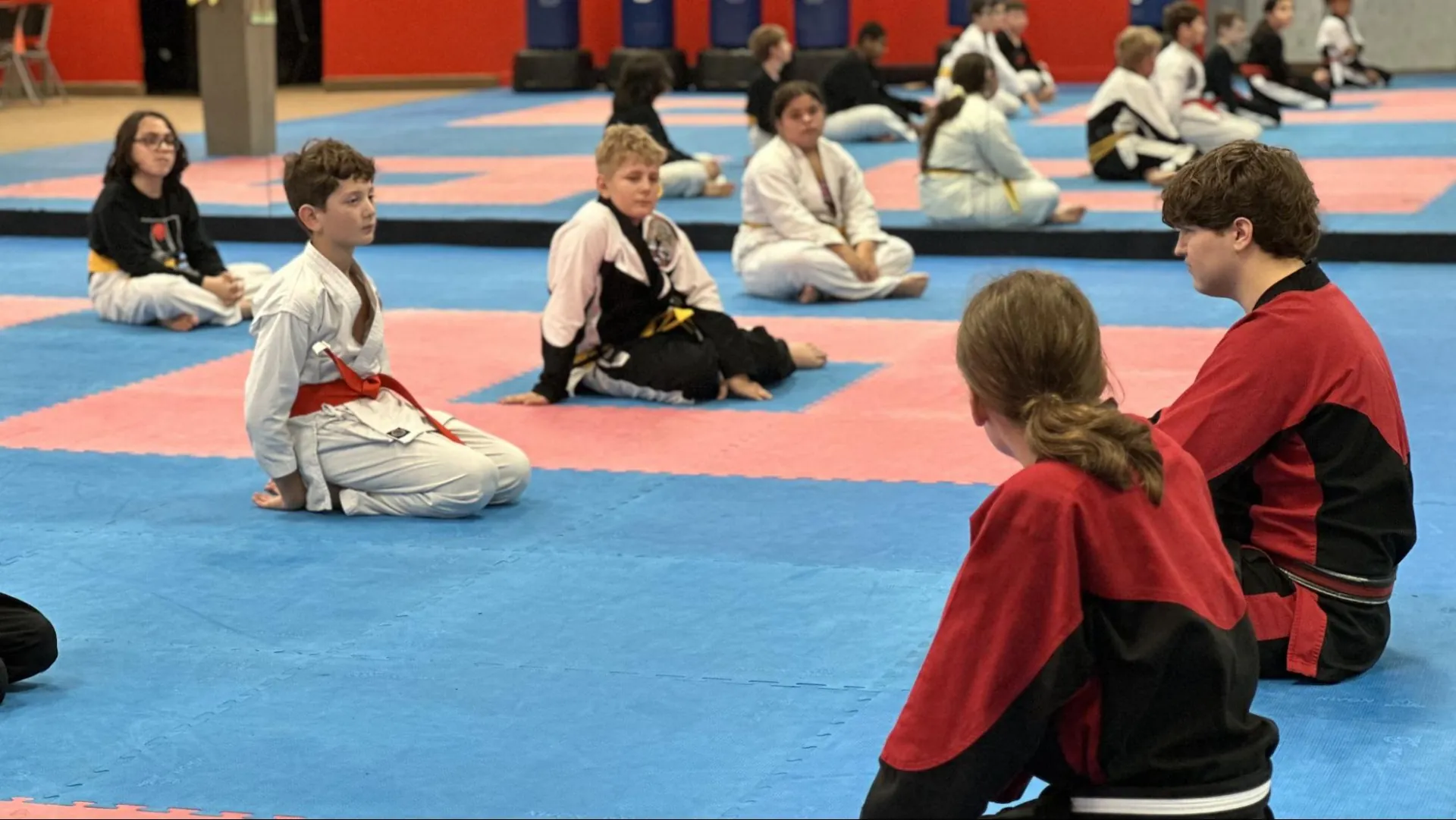
Inside the dojo, outside digital distractions disappear. Instructors use consistent physical cues, such as returning to the "ready stance" , to teach children how to reset their attention on command.
By watching an instructor demonstrate a multi-step movement, holding that sequence in mind, and reproducing it physically, children train their selective attention.
This mental discipline translates directly to school, helping students stay focused during tests and listen to teachers without needing repeated reminders.
2. Working Memory and Pattern Processing Through Kata
Traditional forms, known as kata, are detailed sequences of defensive and offensive movements performed against imaginary opponents.
Learning a kata requires a child to memorize precise angles, foot positions, breathing patterns, and transitions.
By chunking complex patterns into individual movements and assembling them over weeks of practice, children develop working memory capacity and learn how to approach complex academic subjects systematically.
3. Genuine Self-Esteem Built Through Earned Progression
Shallow praise rarely builds lasting confidence in children. Real self-belief is forged when a child struggles to master a difficult stance, practices through frustration, and experiences the breakthrough of success.
The traditional karate belt system provides a clear roadmap of effort and reward. Because stripes and belt ranks are earned through demonstrated personal improvement rather than mere attendance, children gain genuine self-assurance that cannot be shaken by playground teasing.
Karate for Children with ADHD and Sensory Processing Needs
Parents often ask if karate is suitable for children who have attention-deficit/hyperactivity disorder (ADHD), mild autism spectrum traits, or sensory processing challenges.
When taught in a structured, positive setting, karate is one of the most effective physical activities for neurodivergent children.
How the Dojo Calms Overstimulated and Restless Kids
Children who struggle with attention or emotional regulation rarely act out intentionally. More often, they feel overwhelmed by poorly defined expectations, sensory overload, or physical restlessness.
Traditional karate supports these needs through three specific mechanisms:
Clear, Predictable Routines:
Children with ADHD and sensory sensitivities thrive in consistent environments. Every karate class follows a reliable rhythm:
- bowing in
- Warm-ups
- skill drills
- form practice
- calm meditation.
Expectations are posted and practiced, reducing anxiety.
Positive Redirection of Physical Energy:
Telling a hyperactive child to simply sit still and stop fidgeting often causes stress. Karate works with a child's natural physical energy.
Fast-paced movement drills allow children to release restless energy productively, making it much easier to concentrate when it is time to sit and listen.
Sensory and Proprioceptive Input:
Training barefoot on textured mats provides direct sensory feedback through the soles of the feet, grounding the nervous system.
The deliberate pushing, pulling, and striking of padded targets delivers deep proprioceptive input, which helps calm sensory-seeking children and stabilizes low muscle tone.
Karate vs. Taekwondo: What Parents Should Know
When researching martial arts in the Rochester and Greece area, parents frequently ask about the practical difference between traditional Karate and Taekwondo.
While both sports teach discipline and respect, their physical biomechanics and training philosophies differ:
Traditional Karate (Isshin-Ryu):
Focuses on balanced hand-to-foot combinations, close-range defensive leverage, and grounded, upright stances.
Punches, blocks, and kicks are weighted evenly. The upright stances characteristic of Isshin-Ryu Karate mimic natural walking postures, placing minimal torque on growing knees and hip joints while prioritizing practical self-defense.
Taekwondo:
Primarily emphasizes fast, high, spinning kicks and Olympic-style tournament sparring.
While athletic and exciting, the heavy reliance on high kicks requires extreme hip flexibility and repetitive unilateral kicking drills that can be physically demanding for younger children.
For parents seeking practical self-defense, grounded core posture, and balanced physical development, traditional Isshin-Ryu Karate offers a gentle, versatile foundation for young bodies.
Is Karate Good for Kids with Behavior Issues?
When a child exhibits defiance, low frustration tolerance, or frequent behavioral pushback at home and school, parents are often hesitant to introduce an activity that involves punching and kicking.
In reality, traditional martial arts alters behavioral patterns by changing the child's underlying relationship with authority, emotional frustration, and accountability.
Rather than relying on punishment, traditional karate resets behavioral patterns through three distinct psychological mechanisms:
Eliminating Adversarial Power Struggles Through Dojo Etiquette:
Children with oppositional tendencies frequently lock horns with parents and teachers because corrections feel personal.
In the dojo, structure is depersonalized through universal ritual. Every student, from beginner to master instructor, bows upon entering the floor and responds with respectful terminology.
Respect is modeled as mutual courtesy rather than forced compliance, disarming defiance and teaching children to accept guidance comfortably.
Replacing Impulsive Reactions with Measured Responses:
Defiant or disruptive outbursts typically occur when a child feels overwhelmed and defaults to immediate fight-or-flight reactions.
In karate, students practice staying calm under mild, controlled pressure. When a drill feels challenging, or an instructor provides constructive correction, the student learns to pause, breathe, and reset their posture before reacting.
This practice trains the nervous system to handle correction in everyday life without defensive back-talk or meltdowns.
Intrinsic Motivation Through Non-Subjective Achievement:
Children with behavior challenges often feel unfairly labeled or singled out at school. Karate removes this friction by offering an objective, merit-based system.
A child cannot argue their way to a new belt rank: promotion requires verifiable mastery of stances and forms.
Experiencing the direct relationship between personal effort and tangible achievement teaches young minds that cooperation and consistency yield greater personal rewards than rebellion.
How Karate Promotes Mental Health in Children
Mental wellness is just as vital for children as physical health. Today's youth face unprecedented levels of academic pressure, social media scrutiny, and digital overstimulation.
Karate serves as a grounding physical anchor that nurtures emotional equilibrium.
Decompressing After the School Day
Children absorb stress throughout the school day. After sitting quietly and navigating social dynamics for seven hours, pent-up tension often manifests as irritable behavior, anxiety, or emotional outbursts at home.
Karate training provides a constructive, safe physical outlet. Striking padded focus mitts, executing sharp kicks, and shouting with controlled breathing releases endorphins that reduce cortisol levels, helping children feel calm and emotionally relaxed.
A Safe Community Free from Digital Metrics
Inside the dojo, there are no smartphones, video games, or popularity contests.
Every student wears the same traditional uniform (gi), leveling social differences and eliminating peer competition.
Children work together in a supportive community where respect is mandatory, allowing them to forge real, face-to-face friendships centered around shared personal growth.
Why Age-Specific Programs Matter: The Murray’s Martial Arts Approach
A significant shortcoming in many local martial arts studios is the practice of combining four-year-olds and fourteen-year-olds into the same crowded beginner class.
A preschooler learns through playful movement and immediate praise, while an adolescent needs technical depth, biomechanical explanations, and personal accountability. Teaching these age groups together shortchanges both.
At Murray’s Martial Arts, our youth curriculum is divided into three distinct developmental tiers to ensure every student learns at their optimal pace:
Murray’s Martial Arts Youth Curriculum
| Age Group | Program Focus | Primary Growth Outcomes |
|---|---|---|
| Ages 4 to 6 | Karate Fundamentals: Build Confidence | Listening reflexes, balance, coordination, spatial awareness, and early positive wins. |
| Ages 7 to 9 | Karate Fundamentals: Build Discipline | Anti-bullying confidence, sustained focus, personal responsibility, and earned effort. |
| Ages 10 to 15 | Traditional Isshin-Ryu: Build Leaders | Authentic kata, safe body leverage, leadership skills, and controlled point sparring. |
Ages 4 to 6
- Program Focus
- Karate Fundamentals: Build Confidence
- Primary Growth Outcomes
- Listening reflexes, balance, coordination, spatial awareness, and early positive wins.
Ages 7 to 9
- Program Focus
- Karate Fundamentals: Build Discipline
- Primary Growth Outcomes
- Anti-bullying confidence, sustained focus, personal responsibility, and earned effort.
Ages 10 to 15
- Program Focus
- Traditional Isshin-Ryu: Build Leaders
- Primary Growth Outcomes
- Authentic kata, safe body leverage, leadership skills, and controlled point sparring.
Ages 4 to 6: Karate Fundamentals • Build Confidence
Our youngest students learn through engaging games, functional movement drills, patient repetition, and continuous positive reinforcement.
Rather than overwhelming early learners with complex technical theory, classes focus on foundational listening skills, gross motor balance, and personal space awareness.
Creating frequent small wins allows shy or hesitant young children to step out of their shells while having fun.
Ages 7 to 9: Karate Fundamentals • Build Discipline
As children advance into elementary school, they encounter higher academic workloads and complex social dynamics, making them ready for greater personal accountability.
This curriculum emphasizes perseverance, goal setting through belt progression, and vocal boundary setting for anti-bullying protection.
Training instills the focus and self-discipline required to complete school homework and household responsibilities without constant parental reminders.
Ages 10 to 15: Traditional Isshin-Ryu Karate • Build Leaders
Older youth and teens train directly in authentic Isshin-Ryu Karate, studying classical forms (kata), practical self-defense, and real leadership skills.
White Belt marks the beginning of an accountable personal journey. To protect student safety and ensure emotional maturity, sparring (kumite) is introduced only after a student earns their Yellow Belt.
When point sparring takes place, it is conducted under strict non-contact or light-contact parameters with mandatory protective gear under certified Sensei supervision.
What Makes Murray’s Martial Arts a Trusted Dojo in Rochester and Greece, NY
Selecting a martial arts school is an important family decision. While there are several options across Upstate New York, Murray’s Martial Arts has built its reputation as a leading youth dojo by holding firm to high instructional standards, small-group attention, and a family-first atmosphere.
We do not run our dojo as an aggressive fight club, nor do we operate as a commercial belt mill that issues unearned promotions.
Families across Greece, Hilton, Parma, Irondequoit, and the Greater Rochester area choose Murray's Martial Arts for several key reasons:
Strictly Age-Bracketed Classes:
We never combine young children with teenagers in beginner classes. Our age groups (ages 4 to 6, 7 to 9, and 10 to 15) ensure lessons match your child's developmental stage.
Authentic Isshin-Ryu Lineage:
Students learn a respected, traditional martial art that emphasizes balanced stances, defensive joint leverage, and classical kata rather than acrobatic sport stunts.
Safety-First Sparring Standards:
Beginners never spar. More advanced students only begin controlled sparring drills after demonstrating maturity and earning their Yellow Belt, always wearing full protective gear under light-contact rules.
Daily Hospital-Grade Sanitization:
Our high-density mats are sanitized after every training block to ensure an exceptionally clean, healthy environment.
Dedicated Support for Shy and Energetic Kids:
Our Senseis understand child development. Whether your child is introverted and easily overwhelmed by loud team sports, or needs help channeling high energy into positive focus, our instructors know how to guide them.
100% Active Mat Time:
There are no bench-warmers at Murray's. Every student participates fully from the opening bow to the final stretch.
Serving Families Across Monroe County
Enrolling in an extracurricular activity must fit into a busy family routine. Conveniently located on Dewey Avenue just minutes off Route 390 and the Lake Ontario State Parkway, Murray’s Martial Arts provides an accessible regional home for families seeking quality instruction without complex travel logistics.
We understand the scheduling demands of modern households. Our class timetables are designed so parents with children in different age brackets can plan their evenings efficiently, whether commuting from adjacent neighborhoods in Northwest Greece and Hilton, or making the quick cross-town drive from Webster, Brighton, or Henrietta.
With comfortable viewing spaces that allow parents to work or unwind while their children train, our dojo is a welcoming community partner dedicated to your child's long-term success on and off the mat.
Help Your Child Build Strength, Focus, and Confidence
The physical, mental, and behavioral benefits of karate extend far beyond the training floor.
When children learn to stand with balanced posture, respect their peers, channel their energy productively, and conquer hard milestones through steady practice, they carry those habits into every classroom, playground, and future relationship.
If you are ready to see how structured, traditional karate can help your child grow stronger, calmer, and more confident, we invite your family to visit our dojo.
Meet our Senseis, watch a class, and see the difference our age-bracketed programs make.
Ready to see it for yourself?
EXPLORE OUR PROGRAMSFrequently Asked Questions
Keep Reading
How to Choose the Right Karate Dojo for Kids
A parent's guide to finding a safe, supportive dojo — what to look for in instructors, facilities, and long-term value.
Kids & ConfidenceSelf-Defense and Safety Skills for Preschoolers in Greece, NY
What real safety training looks like for ages 3 to 6 — boundaries, listening habits, and confidence, never combat.
Parent ResourcesEverything You Need to Know Before Your Child’s First Karate Self-Defense Class in Greece, NY
What to expect, how to prepare, and why the first class at Murray’s is built to make shy kids feel right at home.
Kids & ConfidenceHow Kids Karate Anti-Bullying Strategies Build Confidence in Greece, NY
Real bullying prevention starts with posture, voice, and emotional control — here is how Isshin-Ryu training builds all three.
Parent Resources5 Essential Skills in Practical Self-Defense for Children in Northwest Rochester
Five practical physical skills and a prevention-first mindset that help children recognize danger, set boundaries, escape safely, and seek help.
Parent ResourcesFrom Shy to Social: How Martial Arts in Hilton Helps Introverted Kids Make Friends
How structured youth karate gives quiet, introverted children a safe way to build confidence, friendships, and social skills.
Parent ResourcesWhat Age Should Children Learn Self-Defense? Youth Karate in Rochester, NY
A parent's guide to readiness signs and what age-appropriate self-defense looks like from ages 4 to 15.