Quick Summary: At What Age Should a Child Learn Self-Defense?
Children can safely begin learning foundational personal safety habits as young as age 4. Early childhood classes (ages 4 to 6) focus on balance, spatial boundaries, and finding an assertive voice. Physical grip escapes and de-escalation skills develop naturally during the elementary years (ages 7 to 9), while biomechanical leverage and traditional martial arts mechanics are best mastered by pre-teens and teens (ages 10 to 15).
What Personal Safety Really Means to Rochester Parents
When parents hear the words "self-defense," it is easy to picture dramatic martial arts movies or worry about dangerous situations. But when you ask moms and dads across Rochester and Greece what they truly want for their children, the goal is much warmer and more grounded.
Parents want their children to walk with confidence. They want them to speak up when someone cuts in line or crosses a boundary on the school bus. They want them to handle playground disagreements without tears, listen the first time directions are given, and carry a quiet inner strength that helps them feel safe wherever they go.
True youth self-defense is not about fighting: it is about building life skills. In traditional karate, safety is an evolving journey that grows alongside your child.
- For a four-year-old, self-defense means knowing where their personal space begins and finding the courage to say "Stop."
- For an elementary student, it means de-escalating teasing and avoiding playground trips.
- For a teenager, it means keeping a level head under peer pressure and knowing how to slip out of an unwanted wrist grab using simple physics.
If you are exploring kids' self-defense programs in Rochester, New York, finding a dojo that understands youth development makes all the difference. Located at 4410 Dewey Avenue in Greece, NY 14616, Murray’s Martial Arts provides family-focused youth karate designed to build practical safety habits in a supportive, positive environment.
Serving families across Greece, Hilton, Parma, Irondequoit, and greater Monroe County, our mission is to help children thrive on and off the mat.
The Parent Readiness Checklist: 4 Signs Your Child Is Ready to Start
Parents often ask whether their child is too young, too shy, or too energetic for martial arts. Age is only one part of the equation: developmental readiness is what really matters.
Here are four simple indicators that your child is ready to try an introductory karate class:
- 1They can follow simple, two-step directions: If your child can follow basic routines like taking off their shoes and finding a spot on the mat, they will feel right at home.
- 2They can manage short periods away from you: Our beginner classes are 30 minutes long. If your child can participate while you watch comfortably from our viewing area, they are ready for the group dynamic.
- 3They are developing gross-motor coordination: Can they hop on one foot, run without tripping often, or mimic movements? Following the physical guidelines of the American Academy of Pediatrics, karate channels these natural motor milestones into balanced coordination.
- 4They need a positive outlet for energy or confidence: Whether your child is quiet and hesitant around new groups, or has boundless after-school energy that needs purposeful direction, martial arts meet them right where they are.
Developmental Breakdown: What Self-Defense Really Means at Every Age
Children go through remarkable physical and cognitive leaps between preschool and the teenage years.
A one-size-fits-all safety class simply does not work because a five-year-old learns through imaginative play and enthusiastic encouragement, while an adolescent needs biomechanical explanations, spacing drills, and real-world strategy.
By separating classes into dedicated age brackets, instructors can tailor lessons to match your child's emotional maturity and attention span.
| Developmental Stage | Typical Age | Core Safety Focus | Primary Skills Developed |
|---|---|---|---|
| Early Childhood | Ages 4 to 6 | Awareness, listening, and voice | Personal space awareness, a confident "stop" voice, balance, and safely finding trusted adults. |
| Elementary Years | Ages 7 to 9 | De-escalation and grip releases | Confident body language, safe breakfalls to prevent sports trips, and wrist-release physics. |
| Pre-Teens & Teens | Ages 10 to 15 | Leverage and traditional karate | Authentic Isshin-Ryu kata, grab escapes, spatial management, and smart decision-making under stress. |
Early Childhood
- Typical Age
- Ages 4 to 6
- Core Safety Focus
- Awareness, listening, and voice
- Primary Skills Developed
- Personal space awareness, a confident "stop" voice, balance, and safely finding trusted adults.
Elementary Years
- Typical Age
- Ages 7 to 9
- Core Safety Focus
- De-escalation and grip releases
- Primary Skills Developed
- Confident body language, safe breakfalls to prevent sports trips, and wrist-release physics.
Pre-Teens & Teens
- Typical Age
- Ages 10 to 15
- Core Safety Focus
- Leverage and traditional karate
- Primary Skills Developed
- Authentic Isshin-Ryu kata, grab escapes, spatial management, and smart decision-making under stress.
Ages 4 to 6: Building the Safety Foundation Through Play and Awareness
Preschool and kindergarten years are all about exploration. Children at this stage are still learning how their bodies move, how to share playground equipment, and how to focus in group settings.
At this age, safety has nothing to do with fighting: it is about learning everyday boundaries and keeping their bodies safe.
Our Karate Fundamentals program for young children focuses on positive, playful movement:
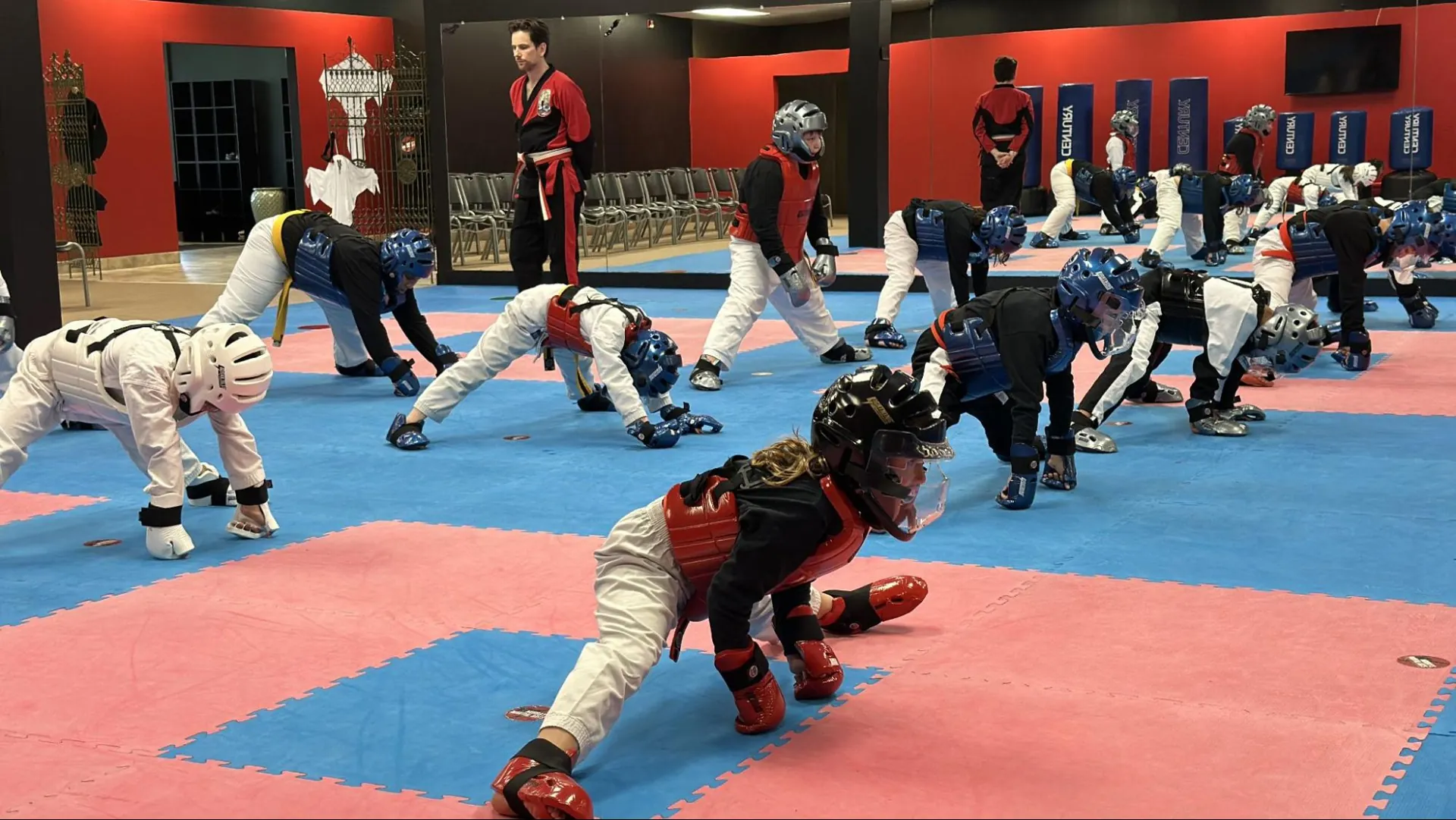
- The Personal Space Bubble: Young children often stand too close to peers without realizing it. We use creative games to teach them what personal space feels like, showing them how to take a balanced step back into a comfortable ready stance.
- Finding Their Strong Voice: Many children freeze or whisper when they feel uncomfortable. We practice looking an adult or peer in the eyes and using a clear, respectful voice to say, "Please stop, I do not like that." This builds the confidence needed to alert teachers and parents quickly.
- Safe Tumble and Fall Mechanics: The most common safety hazard for a five-year-old is gravity. Tripping on playground mulch, slipping on winter sidewalks, or falling off bicycles are everyday risks. We teach children how to tuck their chins, protect their heads, and roll smoothly, turning potential injuries into minor bumps.
Ages 7 to 9: Handling Playground Dynamics, Teasing, and Everyday School Life
Elementary school marks a big step in a child's social independence. Children spend hours in bustling environments like school cafeterias, recess fields, and hallways. This is usually the stage where peer teasing, roughhousing, and boundary-testing first appear.
For elementary students, personal safety focuses on calm de-escalation and non-violent problem-solving:
- Projecting Grounded Confidence: Children who look down, slump their shoulders, or seem uncertain are often singled out for playground teasing. Through foundational karate stances, children learn to stand tall, keep their eyes forward, and hold a balanced posture that naturally deters negative attention.
- Simple Wrist and Backpack Releases: If another student grabs their arm, sleeve, or backpack strap during play, kids do not need to punch or kick. We teach simple body mechanics: how to rotate the wrist toward the weakest point of the grip (the thumb), step back to a safe distance, and calmly report the issue to an adult.
- The Emotional Pause Button: When teased or frustrated, elementary children can react impulsively. Partner drills in the dojo teach students how to pause, take a deep breath, and reset their posture before responding, preventing minor playground disagreements from escalating into school disciplinary issues.
Ages 10 to 15: Practical Technique, Body Leverage, and Quiet Leadership
As young people enter middle school and high school, their world expands. They walk to neighborhood friends' houses, participate in school sports, and navigate complex social dynamics.
They need realistic safety tools that work regardless of their physical size or whether they have hit their growth spurt yet.
At this level, youth self-defense transitions into authentic, traditional martial arts:
- Body Leverage Over Raw Muscle: A middle schooler cannot rely on sheer physical strength against someone who may be taller or heavier. Students learn how to drop their center of gravity, brace their core, and use rotational hip power to redirect force safely.
- Escapes from Uncomfortable Holds: Training covers structured, practical releases from two-handed wrist grabs, collar pulls, and bear hugs, always prioritizing breaking free and creating space.
- Calm Decision-Making Under Pressure: Through supervised light-contact point sparring (introduced gradually only after students earn their Yellow Belt and show mature emotional control), teens learn to manage distance, read body language, and think clearly without panic.
Modern Safety for Kids: "Tricky People" Instead of "Stranger Danger"
For decades, well-meaning safety education centered around the idea of "Stranger Danger." Modern child safety educators have largely moved away from this concept.
The reality is that most strangers are completely harmless, while many real-world boundary issues involve people a child might already recognize: an older neighborhood kid, an acquaintance, or an overly pushy peer.
Scaring children about every unfamiliar person only creates unnecessary anxiety.
Behavior Over Appearance: Safe Habits for Kids
At Murray’s Martial Arts, we teach children to evaluate behavior rather than appearance. Instead of teaching kids to fear unfamiliar people, we teach them to spot "tricky behavior."
A tricky situation occurs when an adult or older youth asks a child to break family rules, asks them to keep an uncomfortable secret from their parents, or invades their personal space bubble.
By focusing on observable actions rather than scary stereotypes, children learn to trust their instincts and seek help from a trusted adult without living in fear.
Why Traditional Karate Is the Gold Standard for Children’s Self-Defense
When researching kids' self-defense programs in Rochester, parents frequently come across combat gyms that emphasize mixed martial arts (MMA), youth cage fighting, or aggressive kickboxing. While these activities offer vigorous workouts, traditional karate remains the gold standard for developing the whole child.
Karate was developed not as an aggressive sport, but as a discipline of health, character growth, and personal protection.
1. The 5 A's of Everyday Personal Safety
True self-defense begins long before any physical technique is ever needed. Traditional karate instills an everyday prevention mindset known as the 5 A's:
- 1Assessment: Looking around when entering a room, park, or bus, noticing exits, and getting a comfortable read on the environment.
- 2Awareness: Keeping heads up, eyes forward, and smartphones stored away while walking through parking lots or neighborhoods.
- 3Avoidance: Trusting intuition when a situation feels uncomfortable, crossing the street, or walking away from drama before it starts.
- 4Action: Using assertive boundary language or simple leverage releases when an interaction cannot be avoided.
- 5Aftermath: Immediately leaving the area and sharing what happened with parents, teachers, or trusted community figures.
2. Leverage That Works Without Muscle
Children are almost always at a physical size disadvantage compared to older peers or adults. Traditional karate avoids brute-force wrestling.
By lowering their center of gravity and understanding simple skeletal alignment, children learn how body mechanics allow a smaller person to break free from a grip and run to safety.
3. The Power of Walking Away
Children who learn authentic karate are consistently the least likely to get into fights at school.
When a child knows deep down that they can handle themselves physically, the urge to show off or prove something to peers simply disappears.
That quiet inner calm gives them the maturity to shrug off petty playground insults, smile, and walk away with their head held high.
Why Murray’s Martial Arts Is One of the Best Karate Dojos in Rochester and Greece, NY
Choosing a martial arts school is an important family decision. You are not simply choosing an after-school activity: you are selecting the mentors, role models, and community that will help shape your child's character during their most formative years.
Across Upstate New York, Murray’s Martial Arts has earned its reputation as a warm, trusted, and top-tier youth academy.
We are not a corporate franchise with revolving instructors, nor do we run our dojo as an aggressive fight club or a commercial belt mill that hands out colored belts just for showing up.
Here is what makes our academy a premier choice for Monroe County families:
Strictly Age-Bracketed Curriculum:
We never mix preschoolers with teenagers on the training floor.
Our classes are divided into three distinct age groups (ages 4 to 6, 7 to 9, and 10 to 15) so that coaching methods, attention spans, and safety rules fit your child’s developmental stage.
Authentic Isshin-Ryu Karate Lineage:
Students learn traditional Okinawan Isshin-Ryu Karate, translating to the "One Heart Way."
Founded by Master Tatsuo Shimabuku, this style emphasizes natural, upright stances and straight vertical punches that mirror normal human movement, making it remarkably safe on growing joints.
Mentors Who Know Your Child by Name:
Our Senseis are passionate youth educators.
Whether your child is introverted and takes a few weeks to step out of their shell, or is bursting with after-school energy that needs positive redirection, our instructors guide them with patience, humor, and encouragement.
Confidence-First Progression:
Advancement is structured thoughtfully around each student's age and program. When a child is not quite ready for their next rank, our instructors coach them through that moment as a constructive life lesson.
We encourage students to embrace patience, stay focused, and keep working hard. This approach ensures that every child develops authentic self-worth backed by real effort.
100% Active Mat Time:
There are no bench-warmers or sidelines at Murray's.
Every single child is moving, smiling, and participating from the opening bow to the final cool-down.
Live Class Streaming & Distraction-Free Training:
To help students stay focused and get the most out of their class, our training floor remains free of everyday spectator distractions.
Instead, we livestream every single class so you can watch live from your phone or replay the session at home.
Parents also get an up-close look at our program during their initial orientation and are welcomed to observe in person during our designated Evaluation Weeks.
Serving Families Across Monroe County
We understand that committing to an extracurricular program requires a schedule that works for busy parents.
Located on Dewey Avenue just minutes from Route 390 and the Lake Ontario State Parkway, Murray’s Martial Arts offers an accessible regional home for families throughout Monroe County:
- Greece and Northwest Greece
- Hilton and Parma
- Irondequoit
- Rochester, Brighton, Henrietta, Webster, and Fairport
Our classes run on convenient weekly schedules with 30-minute sessions for early childhood learners and 45-minute classes for older youth.
Families with children in different age brackets can plan their evenings smoothly, giving your child high-quality martial arts training without turning your family schedule upside down.
Help Your Child Stand Taller, Safer, and Stronger
The best time for a child to learn personal safety is long before they ever face an uncomfortable playground dispute, an awkward peer situation, or a moment of self-doubt. When children discover how to balance their bodies, speak up with clarity, and trust their own inner strength, they carry those habits into every classroom, sports team, and friendship they will ever have.
If you are curious to see how traditional youth karate can help your child feel safer, calmer, and more confident, we would love to welcome your family to our mats. Come meet our Senseis, tour our facility, and watch an active class in action.
Ready to see it for yourself?
EXPLORE OUR PROGRAMSFrequently Asked Questions
Keep Reading
How to Choose the Right Karate Dojo for Kids
A parent's guide to finding a safe, supportive dojo — what to look for in instructors, facilities, and long-term value.
Kids & ConfidenceSelf-Defense and Safety Skills for Preschoolers in Greece, NY
What real safety training looks like for ages 3 to 6 — boundaries, listening habits, and confidence, never combat.
Parent ResourcesEverything You Need to Know Before Your Child’s First Karate Self-Defense Class in Greece, NY
What to expect, how to prepare, and why the first class at Murray’s is built to make shy kids feel right at home.
Kids & ConfidenceHow Kids Karate Anti-Bullying Strategies Build Confidence in Greece, NY
Real bullying prevention starts with posture, voice, and emotional control — here is how Isshin-Ryu training builds all three.
Parent Resources5 Essential Skills in Practical Self-Defense for Children in Northwest Rochester
Five practical physical skills and a prevention-first mindset that help children recognize danger, set boundaries, escape safely, and seek help.
Parent ResourcesFrom Shy to Social: How Martial Arts in Hilton Helps Introverted Kids Make Friends
How structured youth karate gives quiet, introverted children a safe way to build confidence, friendships, and social skills.
Parent ResourcesWhat Are the Main Physical and Mental Benefits of Karate for Children?
How traditional karate builds fitness, coordination, focus, and emotional self-control — and how our dojo keeps kids safe on the mat.